From Public to Audit-Ready: Why Open Onchain Data Isn't Enough for Institutions
BlackRock's tokenized fund BUIDL has surpassed $2.4 billion in assets under management. The tokenized RWA market has doubled over the past year to exceed $30 billion, while stablecoins now represent a market of approximately $300 billion. Blockchain is no longer an emerging technology—it is becoming part of the financial infrastructure institutions operate every day.
The challenge is no longer accessing blockchain data. The challenge is determining whether that data is complete, consistent, and reliable enough to support settlement, reconciliation, compliance, and audit.
Unlike traditional financial systems, blockchains produce raw execution records rather than structured financial data. Every transaction must be decoded, indexed, and validated before it becomes usable. Miss a single decoding step, and the transaction quietly disappears from the dataset without generating an error. During a one-hour sample on Solana, the Phoenix program alone produced 94,587 instructions that could not be decoded because the required interface definition (IDL) was unavailable.
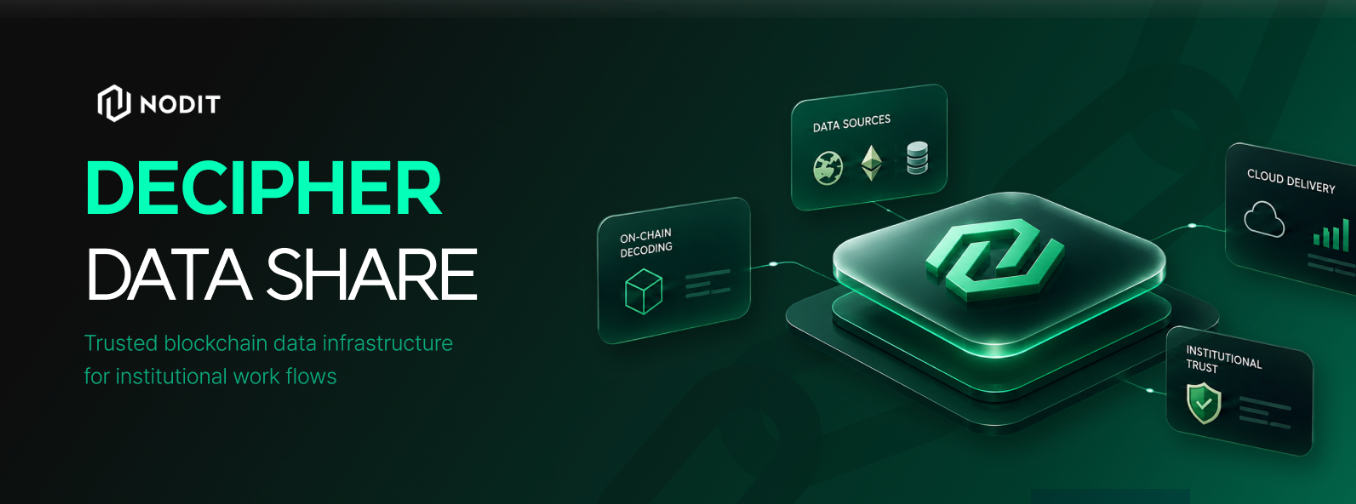
This report explores:
- Why traditional financial data and blockchain data are fundamentally different
- Why decoding coverage and data consistency determine whether blockchain data is audit-ready
- The architectural approaches used across the industry to address these challenges
- How Nodit DataShare delivers institutional-grade blockchain data through direct node operation, comprehensive IDL coverage, and SOC 2-certified infrastructure
As institutions continue adopting blockchain infrastructure, the ability to trust the underlying data becomes just as important as the applications built on top of it.
🔎About Nodit
Nodit is an enterprise-grade Web3 platform that provides reliable node and consistent data infrastructure to support the scaling of decentralized applications in a multi chain environment. The core technology of Nodit is a robust data pipeline that performs the crawling, indexing, storing, and processing of blockchain data, along with a dependable node operation service. Through its new Validator as a Service (VaaS) offering, Nodit delivers secure, transparent, and compliant validator operations that ensure stability, performance visibility, and regulatory assurance.
By utilizing processed blockchain data, developers and enterprises can achieve seamless on chain and off chain integration, advanced analytics, comprehensive visualization, and artificial intelligence modeling to build outstanding Web3 products.