From Stablecoins to Tokenized Assets: Digital Asset Infrastructure Redesigned to Institutional Standards
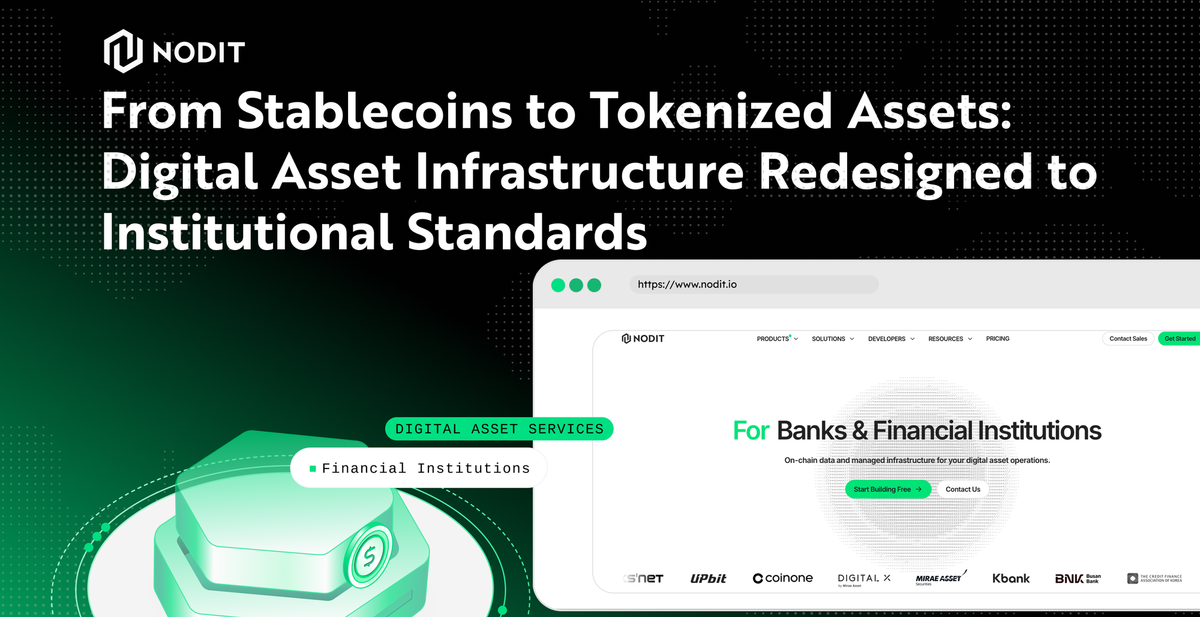
As stablecoins and tokenized assets move into mainstream financial services, more financial institutions are assessing digital asset infrastructure. Nodit, Lambda256's blockchain infrastructure platform, has relaunched its website, nodit.io, with this shift in mind.
Financial institutions, exchanges, and payment providers can now explore Nodit by business objective, cost, and operational needs.
Financial institutions rarely choose an on-chain infrastructure provider on technical specifications alone. Engineering teams look at performance and scalability. Security and compliance teams want documented proof that controls are actually in place. Business and procurement teams ask what the infrastructure can be used for, what it will cost, and what it takes to run.
Nodit has seen these needs firsthand while supporting large-scale live services for leading Korean exchanges and working with financial institutions across APAC on stablecoin and tokenized asset projects. More recently, it extended its offering to Validator-as-a-Service, starting with Solana.
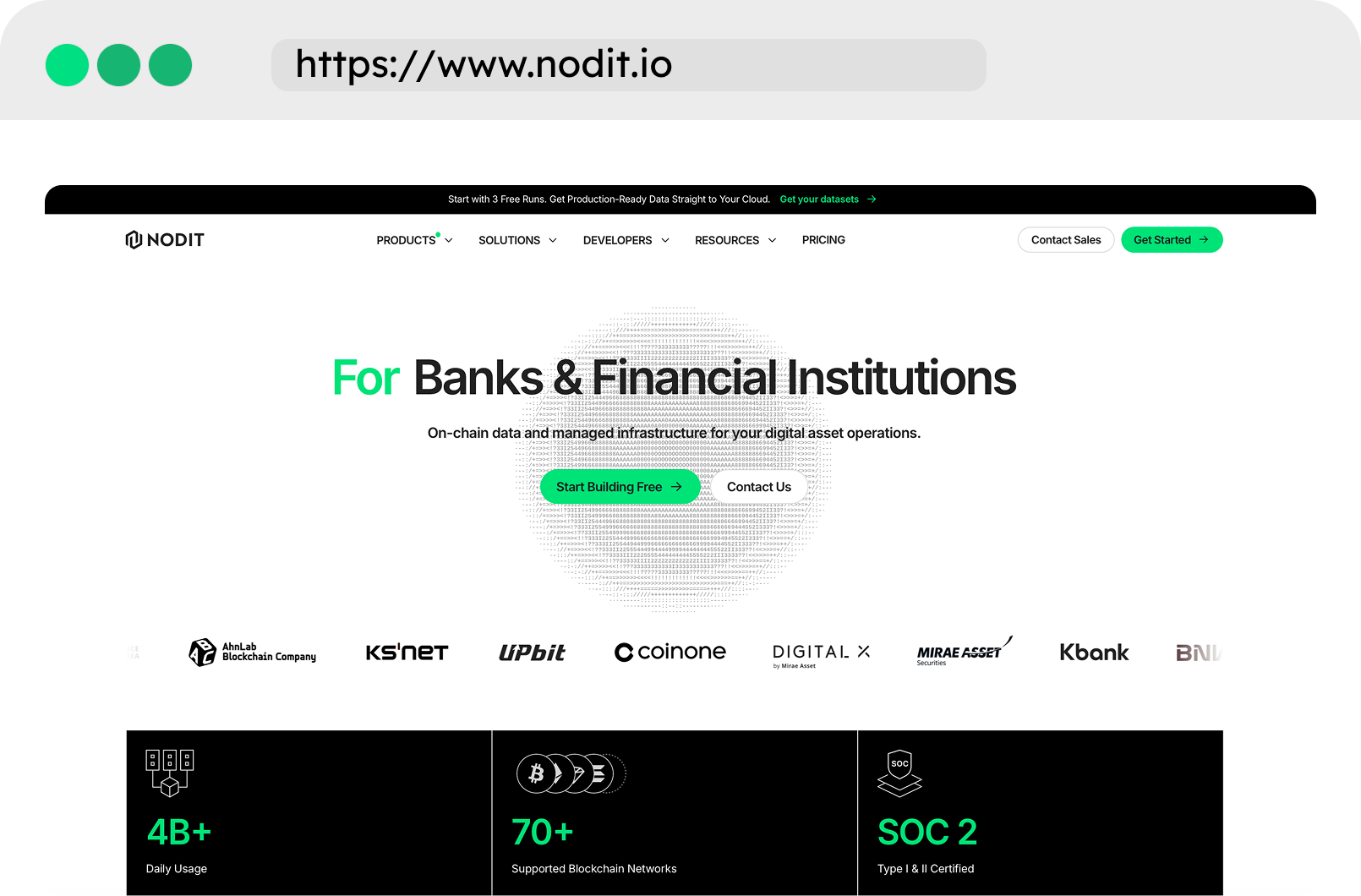
The new site is organized so that every team involved in an evaluation can find what it needs in one place.
"Financial institutions look beyond whether they can call an API. They need to know the infrastructure holds up in live operations, meets their security and operational standards, and keeps costs predictable as usage grows. This redesign is focused on making those judgments easier." Jae Kim, CSO, Lambda256
What's New
Solutions by Business Type
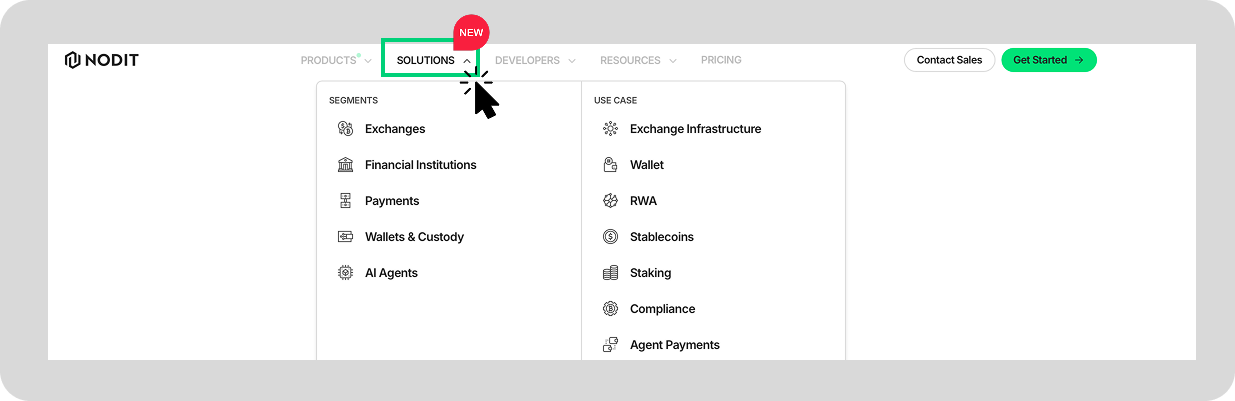
Separate pages now cover exchanges, financial institutions, payment service providers (PSPs), wallets and custody, and AI agent platforms. Each page maps to concrete use cases such as stablecoins, tokenized real-world assets (RWA), staking, compliance, and exchange infrastructure, together with examples from customers already running on Nodit.
Products Organized into Three Areas
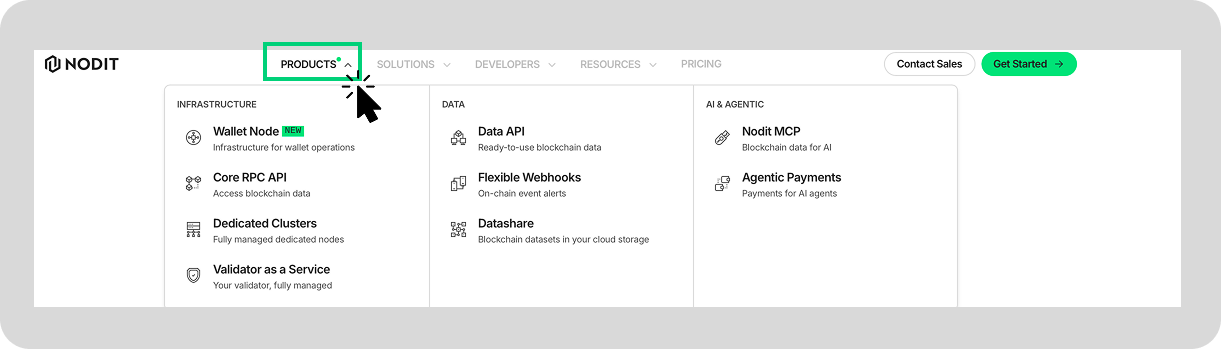
- Infrastructure: Core RPC API, Dedicated Clusters, Validator as a Service, Wallet Node
- Data: Data API, Flexible Webhooks, and Datashare, which sends blockchain datasets straight into a customer's own cloud environment
- AI & Agentic: Nodit MCP, Agentic Payments
From node infrastructure and data queries to AI-driven on-chain payments, the components needed to run a digital asset service can now be reviewed side by side.
Usage-Based Cost Estimator
Enter expected usage and the Plan Finder recommends a suitable plan. Engineering, finance, and procurement staff can gauge infrastructure costs from the earliest stage of review, which helps with budgeting and internal approvals.
Trust Center and Reports for Institutional Review
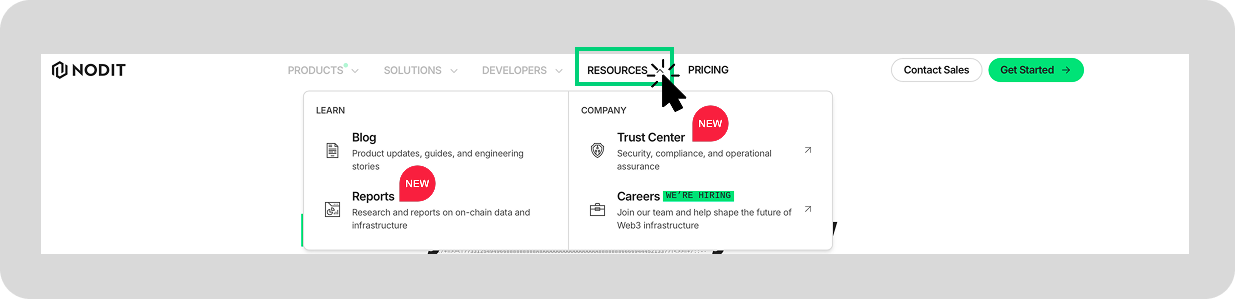
The Trust Center gathers information on security, compliance, service availability, and operational controls. Security and procurement staff can find the materials they typically check in a first-round assessment, including SOC 2 Type II certification status.
Reports offers research on blockchain infrastructure, on-chain data, and digital asset market trends.
Solana Validator Reports Are Moving
The monthly Solana Validator performance reports previously published on the Lambda256 Resources page will now be available on the Reports page of the Nodit website.
Block production and vote performance are public indicators of how reliably Nodit runs its infrastructure. Keeping these reports next to the Nodit platform overview and Trust Center lets institutions review performance data and control frameworks together.
The Lambda256 Resources page will focus on insights and reports for Korean financial institutions, such as on-chain AML and financial crime prevention.
When institutions evaluate an infrastructure provider, they generally look at four things: what it can be used for, what it costs, whether its controls can be verified, and whether it has a real operating track record. With the redesign, institutions can check all four through public materials before speaking with our team, which shortens the early stage of an adoption review.
Developers can sign up at no cost and run integration tests. Even at that stage, they work on the same infrastructure that supports live services for exchanges and financial institutions.
See the redesigned Nodit website at nodit.io.
Lambda256 began as Dunamu's blockchain research lab and was established as a dedicated blockchain company in 2019. It is advancing the commercialization of blockchain technology and a financial data ecosystem through Nodit, a blockchain infrastructure platform for the global market; CLAIR, an ontology-based data analytics solution; and SCOPE, an integrated stablecoin platform for institutions.