Consensus HK 2026 Insights: A Field Report for Financial Institutions
Lambda256 attended Consensus HK and Solana Accelerate APAC in Hong Kong in February 2026. Here is what we saw on the ground — and what it means for financial institutions evaluating blockchain infrastructure.
Institutions Have Moved Past Exploration
The way global institutional investors and traditional financial firms talk about blockchain infrastructure has changed.
At Consensus HK 2026 and Solana Accelerate APAC, that shift was hard to miss. Familiar names — Mirae Asset, ChinaAMC, CME Group, Cumberland, DB Securities — were not there to explore possibilities. They were auditing infrastructure requirements and regulatory alignment for actual production deployment. The conversation had moved on.
As global capital accelerates its move on-chain, the question for Korean financial institutions is no longer whether to engage, but when and on what terms.
Three Structural Shifts We Saw on the Ground
1. RWA: The Focus Has Shifted from Narrative to Execution
The center of gravity in RWA discussions shifted noticeably at this year's event.
Conversations around continuous trading of tokenized equities, exchange connectivity, and institutional collaboration were framed around specific implementation models, not feasibility. Traditional financial institutions have already moved past the observer position — they are now directly evaluating integration models and infrastructure requirements.
The tone was pragmatic. There was broad recognition that tokenizing real-world assets does not automatically generate liquidity. How to design liquidity structures, distribution channels, and sustained participation became the core questions. The benchmark for infrastructure selection has shifted accordingly — from "which chain to issue on" to "which infrastructure can actually hold up in production."
2. DeFi and Capital Efficiency: Protocols Are Becoming Market Infrastructure
DeFi discussions centered on structural changes needed to improve capital efficiency.
The push toward multi-asset collateral frameworks — integrating tokenized equities and real-world assets as collateral — points toward DeFi functioning as programmable capital market infrastructure, not just isolated protocols.
But getting there requires infrastructure to clear a higher bar: fast and consistent liquidation handling, predictable block space behavior, and low-latency execution under sustained load. As AI-driven trading systems and automated strategies push transaction velocity higher, infrastructure will be judged under stress, not in controlled conditions.
3. Execution Infrastructure: Consistency Matters More Than Peak Performance
The central message at Solana Accelerate APAC was not about individual application growth. It was about the reliability of the network execution layer itself.
Lily Liu, President of the Solana Foundation, framed blockchains not simply as platforms for deploying applications, but as foundational layers for capital formation and asset movement — a sign of deepening convergence between on-chain systems and traditional capital market architecture.
The next phase of growth will not be driven by standalone dApps, but by integrated financial networks capable of supporting diverse assets and capital flows at scale.
The Questions Have Changed
Looking back at the questions we heard throughout the event, it was clear these were not about proof-of-concept or kicking the tires. They were specific, operational questions from people ready to build.
- How do stablecoins operate reliably at scale?
- How do you onboard institutions without compromising compliance?
- What metrics actually matter when presenting on-chain rails to asset managers and banks?
- Is the tokenization infrastructure built to withstand a regulator's first serious audit?
These are not questions about peak performance. They are questions about how predictably a system holds up under sustained, real-world demand.
In regulated environments, infrastructure is not judged by how fast it runs under ideal conditions. It is judged by how consistently it performs when markets move fast, traffic spikes, and auditors come knocking.
What Lambda256 Brought to the Table
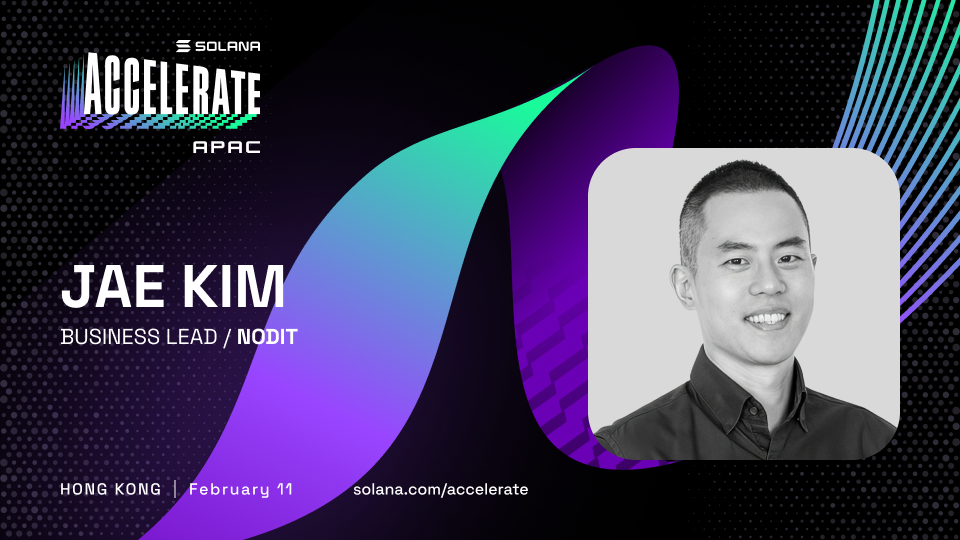
Lambda256 joined the ICM Infrastructure panel at Solana Accelerate APAC, where Jae Kim, Business Lead at Lambda256, spoke alongside representatives from Arcium, Raiku, and DoubleZero on the future of institutional-grade Solana infrastructure in Asia.
Three points anchored our position.
Institutional-grade security.
Nodit is the first Web3 infrastructure provider in Korea to achieve SOC 2 Type II certification. SOC 2 Type II is an internationally recognized standard set by the American Institute of Certified Public Accountants (AICPA), verified through independent audit. It assesses how securely a company stores, processes, and transmits data — and for financial institutions, it is the kind of third-party validation that actually moves internal approval processes forward.
Integration with DoubleZero.
DoubleZero is a physical network infrastructure project that replaces the standard internet transport layer with dedicated fiber, reducing latency and improving execution consistency across blockchain networks. At the event, Lambda256 announced its integration with DoubleZero, becoming the first APAC integrator on the DoubleZero Network. By running Nodit's Solana RPC nodes over dedicated fiber, RPC traffic takes optimized, controlled routes — delivering more consistent block synchronization and lower latency variability, particularly during periods of network congestion.
Bridging on-chain infrastructure to real-world payment rails.
Lambda256 shared its ongoing pilot of USDC-based stablecoin payment infrastructure on Solana, built through an MOU with KSNet — a concrete example of on-chain infrastructure connecting directly to real-world payment systems.
What Financial Institutions Actually Check
The criteria regulated institutions apply when evaluating infrastructure are well-defined.
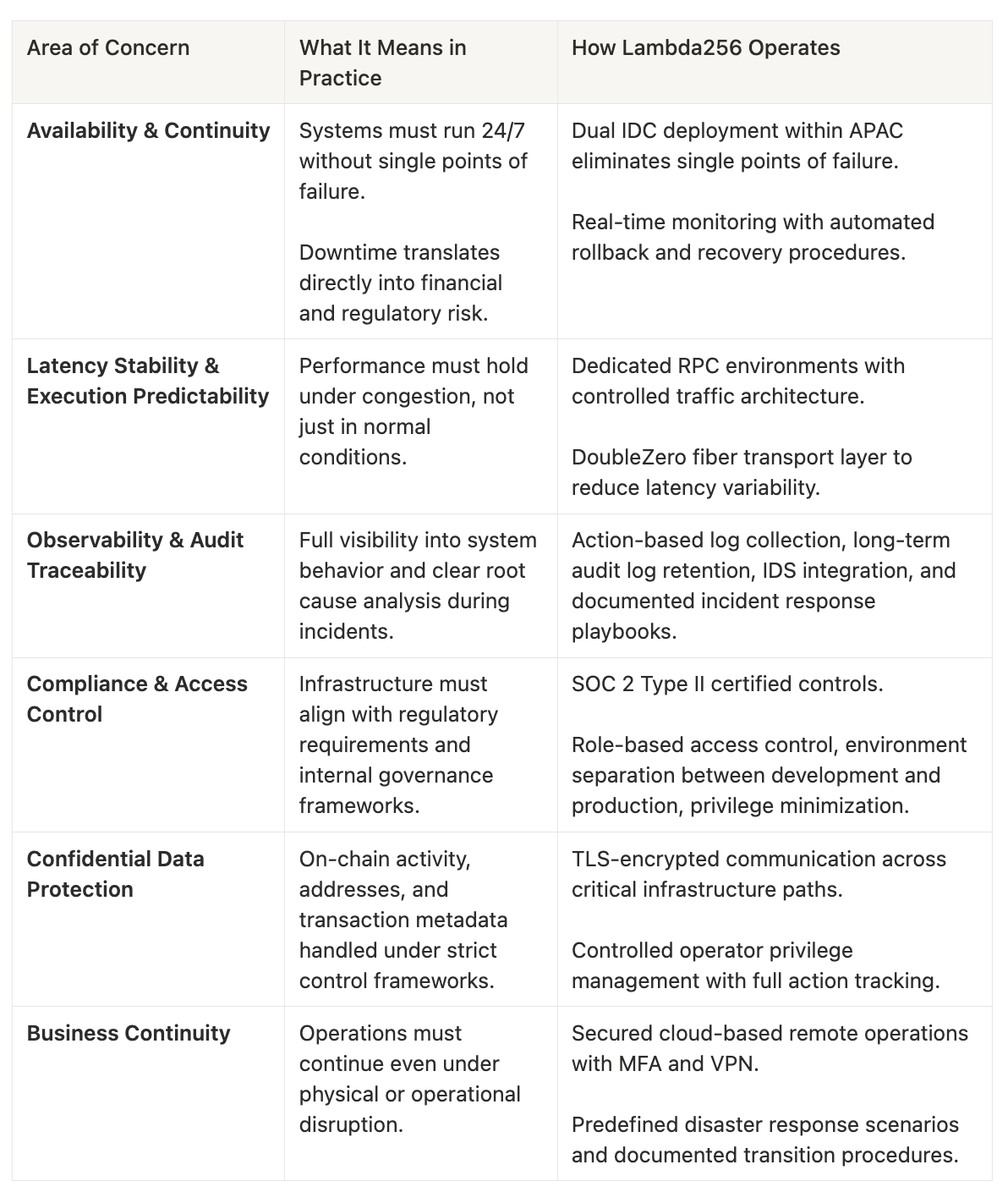
What Running at Scale Actually Looks Like
Lambda256 supports infrastructure for one of the largest digital asset trading ecosystems in Korea. Across the environment surrounding Upbit, the infrastructure processes over 100 million requests per day and handles trillions of KRW in daily trading volume — while maintaining millisecond-level response consistency.
Not benchmark numbers. Numbers from live markets, validated every day.
For institutions evaluating enterprise-grade infrastructure, Lambda256 is ready to discuss deployment models built around resilience, governance, and regulatory alignment.
Final Thoughts
Consensus HK 2026 and Solana Accelerate APAC confirmed what it will take for blockchain infrastructure to earn a place in institutional finance. The case has been made. What comes next is infrastructure that can actually hold up when it counts.
For stablecoins to scale, for tokenization to survive regulatory scrutiny, and for institutions to deploy capital with confidence, the underlying infrastructure needs to deliver speed, stability, traceability, and governance — not as separate considerations, but together.
Lambda256 will continue to work as an infrastructure partner for financial institutions building on blockchain, on a foundation built to meet the standards that regulated environments require.
Related Resources
- Nodit × DoubleZero Technical Integration
- Lambda256 × KSNet MOU Announcement
- Use case study: How Nodit Supports Upbit's Fraud Detection System
About Lambda256
Lambda256 is a blockchain technology company established in 2019, originating from Dunamu's blockchain research division. Built around Nodit, an enterprise-grade Web3 infrastructure platform; Clair, an ontology-based blockchain intelligence solution; and SCOPE, an institutional stablecoin integration platform, Lambda256 leads the commercialization of blockchain technology and the development of financial data ecosystems for global markets.
Contact us: www.lambda256.io